Quick Answer
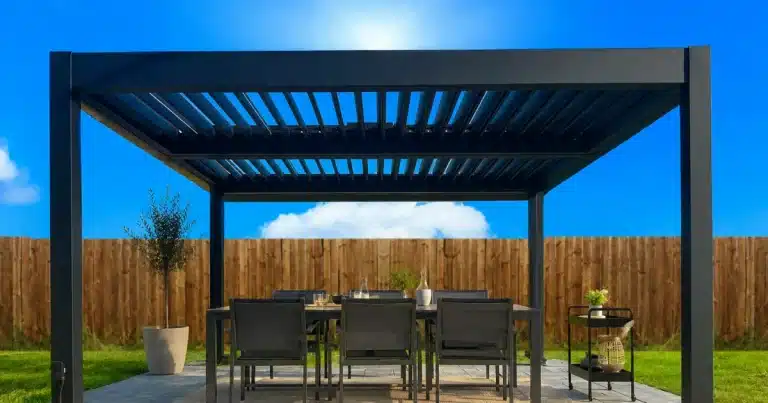
To add motorized shade to your patio, install a heavy-duty aluminum louvered pergola with remote-controlled blades. Knowing how to add pergola shade really comes down to four moves: measure your space, choose a configuration, pick your finish, then set the louvers to block heat and UV or open them for airflow when the breeze rolls in.
North Dakota summers swing from calm, golden evenings to blazing afternoon sun and sudden prairie storms. At Sunspace 3 Season Solutions, we help homeowners across Fargo and the surrounding areas turn an exposed deck into a comfortable outdoor room. A motorized louvered pergola gives you shade on demand, protection when the weather turns, and open sky when you want it. In this guide, we walk you through the practical steps, the choices that matter, and the mistakes worth avoiding, so your patio finally works for you all season long instead of only on the mildest days.
Table of Contents
- Why Motorized Shade Belongs on Your North Dakota Patio
- Step 1: Measure Your Space and Choose a Configuration
- Step 2: How to Add Pergola Shade That Fits Your Home
- Step 3: Choose Your Finish and Lighting
- Step 4: Adjusting the Louvered Pergola Roof for Sun, Rain, and Airflow
- Common Mistakes to Avoid
- FAQ
- Conclusion
Why Motorized Shade Belongs on Your North Dakota Patio
The July sun on the northern plains is relentless, and an open deck gives you nowhere to hide from it. A louvered aluminum roof changes that equation entirely. When the blades close, they block heat and UV, dropping the temperature on your patio while a wide gutter design channels rain safely away from your table.
Closed fully, the roof is 100% waterproof, backed by an IP67 waterproof certification, so a passing thunderstorm no longer ends the evening. Open the blades again and you get up to 80% ventilation, letting warm air rise and a lake breeze move through. That range is exactly what makes reclaiming your evenings outdoors realistic.
For many families, the goal is simple: family meals outdoors without retreating inside by mid-afternoon. If total bug protection matters more to you than open sky, a 3-season vinyl sunroom may be the better fit. But for flexible shade over an existing deck, a motorized pergola is tough to beat.
Step 1: Measure Your Space and Choose a Configuration
Start with a tape measure. A single unit spans up to 197 inches of projection by 275 inches wide on four posts, which covers a generous dining-and-lounging zone. Sketch where the sun sits at six o’clock and where you want those posts to land before you commit to anything.
Next, decide how it connects. You have three ways to build it: a freestanding structure that stands on its own anywhere in the yard, an attach-to-wall version that ties neatly into your house, and a multi-section layout for larger patios. If you’re weighing freestanding pergola installation ideas, picture a poolside lounge, a detached fire-pit corner, or a standalone lakeside retreat set apart from the cabin.
Step 2: How to Add Pergola Shade That Fits Your Home
Matching the structure to your home is where careful planning pays off. The frame is built from 6063-T5 aluminum with a robust powder-coated surface, so it won’t rust, rot, or warp through hard upper-Midwest winters. That durability matters most when the unit lives outside year-round.
The engineering also gives real peace of mind. With the louvers closed, the roof carries a loading capacity of 70 pounds per square foot, and the structure is rated to a wind load of 157 mph. Snow and prairie gusts are simply part of life here, and those numbers were built for it.
These systems are engineered by Sunspace Sunrooms, the manufacturer behind our outdoor living lineup, and they’re installed by our own crews rather than a rotating cast of subcontractors. That continuity is how quality craftsmanship actually shows up on your patio.
Step 3: Choose Your Finish and Lighting
Five frame colors keep the look intentional: White, Driftwood, Bronze, Black, and Gray. Driftwood reads warm and cabin-friendly, Black and Bronze lean modern, and White stays crisp against most siding. Hold a sample against your house before you decide, because outdoor light shifts these tones more than a screen ever will.
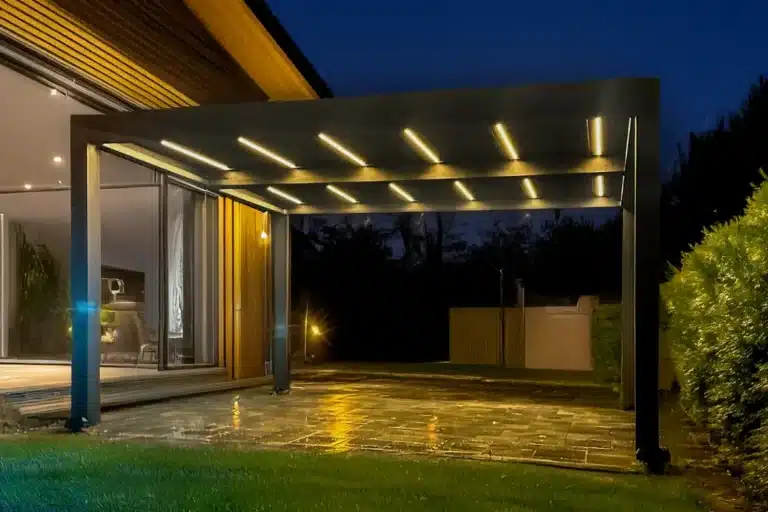
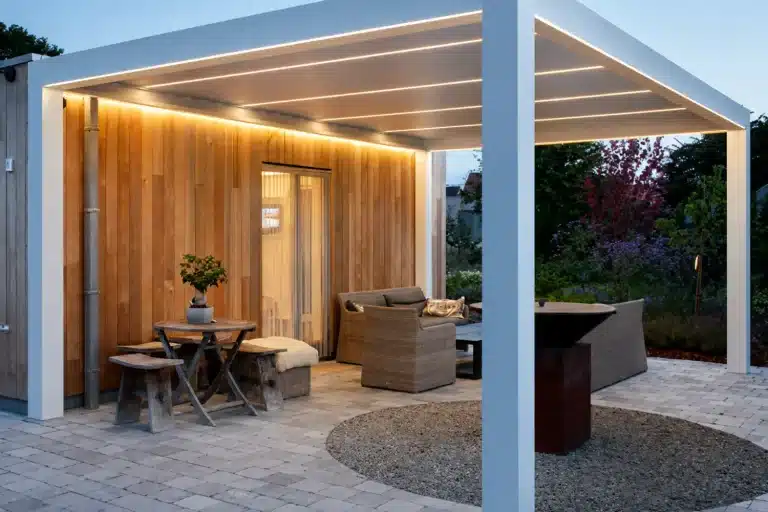
Then there’s the lighting itself. Each blade carries built-in LED strip lighting, and the same remote that turns the louvers also dims the LEDs for brightness control. Your evening ambiance is essentially baked into the roof, no tangle of string lights required to make the space feel finished.
Step 4: Adjusting the Louvered Pergola Roof for Sun, Rain, and Airflow
Here’s the part you’ll use every single day. From the remote, the blades rotate through a full 0 to 120 degree range. Tilt them slightly to filter harsh midday glare, open them wide for stargazing after dinner, or close them tight the moment a storm builds on the horizon.
Adjusting louvered pergola roof blades takes only seconds, and that responsiveness is really the whole point. On a hot afternoon, angle the blades for shade and up to 80% ventilation so trapped heat escapes. When the rain finally arrives, close them fully and the IP67 waterproof roof keeps everyone at the table dry.
Common Mistakes to Avoid
The most common misstep is undersizing. Plenty of folks measure for a small bistro table and later wish they had covered the whole gathering space, so plan around how you actually entertain, not the bare minimum.
Another is treating a pergola like a heated room. It’s an outdoor shade structure, not a sealed enclosure, so if you want true year-round comfort through North Dakota winters, an insulated sunroom is the honest answer instead.
Finally, don’t skip professional installation. A structure rated for 157 mph winds only performs when it’s anchored correctly, which is exactly why the Sunspace 3 Season Solutions team handles the full build from footing to final remote pairing.
FAQ
Can a motorized pergola handle North Dakota winters?
The frame is 6063-T5 aluminum with a wind load rating of 157 mph and a closed-louver capacity of 70 pounds per square foot, so it’s built for tough conditions. That said, it’s an outdoor shade structure, not a heated room. We recommend clearing heavy snow buildup rather than relying on the roof to hold a full winter’s load.
Is a louvered pergola actually waterproof?
Yes, when the blades are fully closed. The roof carries an IP67 waterproof certification and a wide gutter design that channels water away from your seating area, so a summer downpour won’t chase you indoors. Once the rain passes, simply open the louvers again from the remote to let the sun and airflow back in.
What’s the difference between a freestanding and attach-to-wall pergola?
A freestanding pergola stands independently on its own posts, so you can place it over a detached patio, a poolside area, or a lakeside spot away from the house. An attach-to-wall version connects directly to your home for a seamless extension of your living space. Multi-section layouts are also available when you need to cover a larger footprint.
Do I need bug protection with a pergola?
A pergola is open to the sky, so it filters sun and rain rather than insects. If bug-free evenings are your top priority, a screen room or a 3-season sunroom will serve you better. Many homeowners pair the two ideas, using a pergola over the deck and an enclosed room nearby for those mosquito-heavy nights on the lake.
Conclusion
Learning how to add pergola shade to your North Dakota patio comes down to sizing it right, choosing the configuration that fits your yard, selecting a finish, and letting the remote do the daily work of chasing sun and dodging rain.
The payoff is a cooler, more usable outdoor space you’ll actually reach for all summer, with LED lighting and a waterproof roof already built in.
When you’re ready to map it out, the team at Sunspace 3 Season Solutions will help you plan the layout and request a quote tailored to your patio.